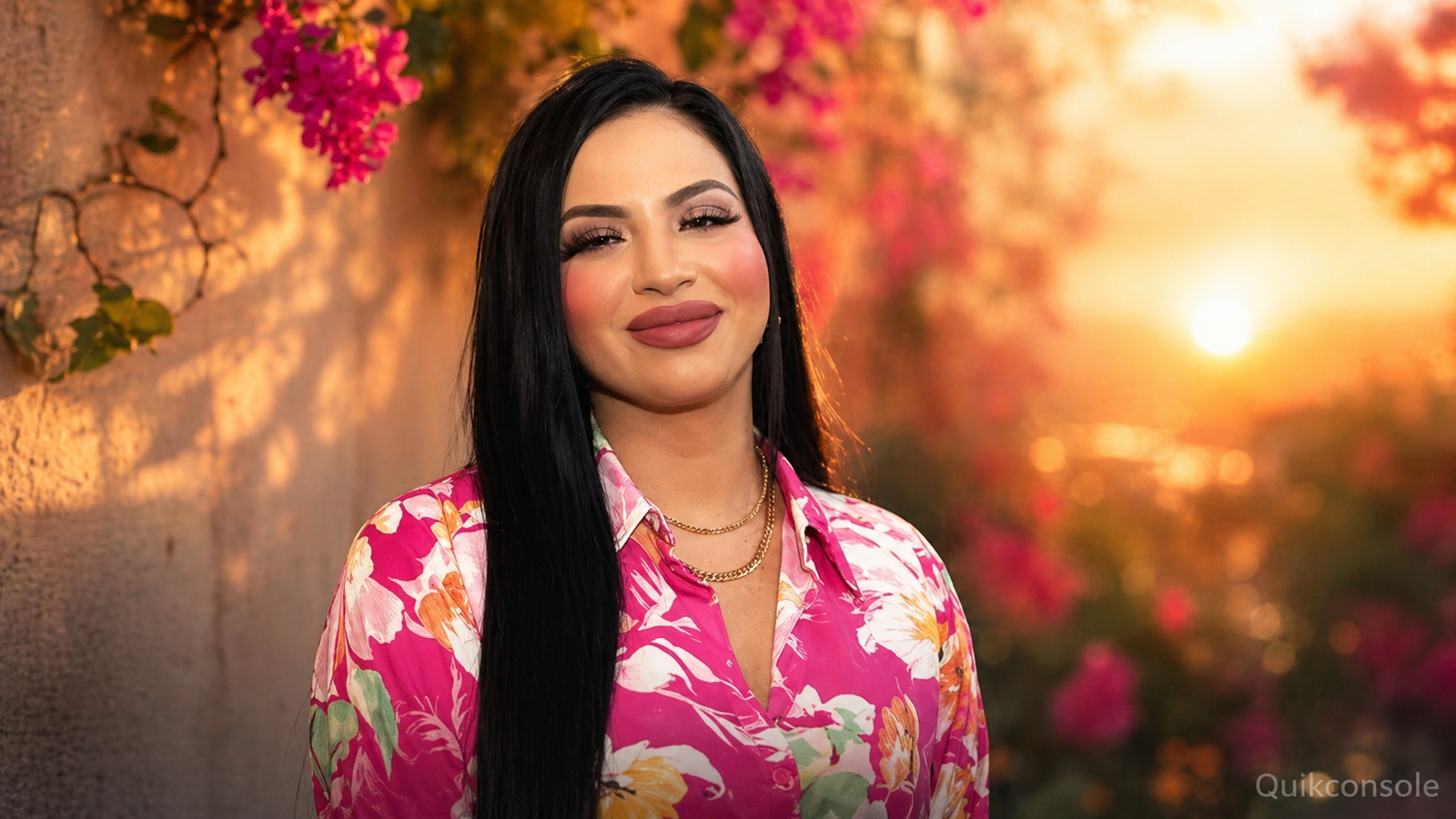
Cynthia Sanchez Vallejo lives in the long shadow of a voice that never really left Mexican music. Her father, Rosalino “Chalino” Sánchez Félix, became a folk hero through corridos that sounded raw, dangerous, and close to the bone. Her brother, Adán Sánchez, followed him into regional Mexican music and died before he turned 20. Cynthia, by contrast, has built her public identity with much more restraint, known less for chasing fame than for carrying a family name that fans still treat with deep emotion.
That tension is what makes her story so searched and so often misunderstood. Readers want to know whether she sings, where she is now, how much money she has, and what kind of life she built after losing both her father and brother. The honest answer is more careful than many online biographies suggest. Cynthia Sanchez Vallejo is a public figure by inheritance, but much of her own life remains private, and the best biography of her has to respect that line.
Early Life and Family Background
Cynthia Sanchez Vallejo is widely identified as the daughter of Chalino Sánchez and Marisela Vallejos Félix. Her father was born in Sinaloa, Mexico, and became one of the most influential figures in corrido and narcocorrido music before his murder in 1992. Her mother has generally kept a lower public profile than the famous men in the family. Cynthia grew up attached to a surname that carried fame, danger, grief, and fierce loyalty among fans.
Most online profiles report that Cynthia was born in the late 1980s, often giving April 7, 1987, as her birth date. That date appears frequently, but it should be treated with care because it is not consistently tied to a primary public record. What is clear is that she was still very young when her father was killed in Culiacán, Sinaloa. Her childhood was shaped by a loss that became not only a family tragedy but also a piece of music folklore.
Cynthia’s older brother was Adán Santos Sánchez Vallejo, better known professionally as Adán Chalino Sánchez. Born in 1984 in California, Adán built his own career as a regional Mexican singer while honoring the father he lost as a child. He became especially popular with younger fans and was seen as the heir to Chalino’s emotional and musical legacy. His death in 2004 left Cynthia as the surviving child most closely associated with the Sánchez family story.
Growing Up as Chalino Sánchez’s Daughter
To understand Cynthia’s public image, it helps to understand what Chalino Sánchez meant to his audience. Chalino was not a polished pop star who entered music through the usual industry routes. He was a Sinaloa-born singer and songwriter whose rough voice, plain delivery, and violent life story made him feel real to listeners who distrusted smooth celebrity packaging. His songs told stories of outlaws, betrayal, pride, survival, and death, often in language that felt close to the streets and ranchos that produced them.
Chalino’s rise came through cassette culture, local performances, and an audience that spread his music before institutions fully caught up. He became known as “El Rey del Corrido,” a title that reflects both admiration and mythmaking. His work helped define the modern public image of the narcocorrido, a form rooted in older Mexican storytelling traditions but tied to drugs, trafficking, and border violence. Even people who debate his legacy tend to agree that he changed the sound and attitude of regional Mexican music.
For Cynthia, that legacy was never abstract. She was not simply related to a famous artist; she was the daughter of a man whose death became part of his legend. Fans kept his songs alive, journalists revisited his killing, and younger artists continued to borrow from his style. That meant her father’s absence remained publicly present, replayed in concerts, documentaries, podcasts, and social media clips.
The Murder That Changed the Family’s Story
Chalino Sánchez was killed in May 1992 after a performance in Culiacán, Sinaloa. The most repeated account of his final night centers on a note handed to him onstage, after which he appeared visibly shaken but continued singing. The contents of that note have never been publicly verified, though it is often described as a warning or death threat. That uncertainty has only made the moment more famous, because fans keep returning to the clip as if it contains the answer to what happened next.
After the performance, Chalino was reportedly taken by armed men and later found dead. His murder remains unsolved, which has left space for theories involving revenge, organized crime, personal enemies, and the risks built into the world he sang about. The lack of a settled legal answer turned the case into one of regional Mexican music’s lasting mysteries. It also meant that Cynthia’s father became frozen in public memory as both artist and victim.
The impact on Cynthia is easy to imagine but hard to document, and that distinction matters. She was a child when the killing happened, and she did not choose for her grief to become part of a public legend. Later reports have described her sadness at seeing videos of Chalino’s final performance circulate online. Her connection to that footage is not the same as a fan’s fascination; for her, it points back to a father.
Adán Sánchez and a Second Loss
Adán Sánchez’s life gave the family story another chapter, and then another tragedy. Performing as Adán Chalino Sánchez, he drew attention as a young singer who could connect his father’s legacy to a new generation. In March 2004, he performed a major concert at the Kodak Theatre in Los Angeles, a milestone often cited in accounts of his rising popularity. He was only 19, but his career already carried the force of inherited memory and teenage devotion.
One week after that concert, Adán died in a car crash in Sinaloa. Reports at the time said the vehicle he was traveling in lost control and rolled, killing him before his 20th birthday. His death stunned fans who saw him as the continuation of Chalino’s musical line. Public mourning was intense, especially in Southern California, where the Sánchez family had deep audience roots.
For Cynthia, Adán’s death meant losing not just a brother but the person who had most visibly carried their father’s name into performance. The family’s story became marked by a painful pattern: a father killed at 31, a son dead at 19, and a daughter left to live with the public memory of both. That history helps explain why readers search for her with such curiosity. She is not a celebrity in the usual sense; she is the living connection to two men whose fans never stopped mourning them.
Public Image and Social Media Presence
Cynthia Sanchez Vallejo has not pursued fame with the same intensity as her father or brother. Her public image is quieter, built around occasional social-media visibility and the continued interest of Chalino’s fans. Spanish-language entertainment coverage has described her as active on TikTok and Instagram, where she has shared glimpses tied to family memory and everyday life. Those appearances have made her familiar to fans without turning her into a traditional performer or full-time celebrity.
That kind of visibility can be misleading if readers mistake it for total openness. A person can post online and still keep most of life private. Cynthia appears to share selectively, especially around the emotional meaning of being Chalino’s daughter and Adán’s sister. Her public presence seems less like a career campaign and more like a controlled relationship with a fan base that already knows her surname.
Some reports describe her as proud of her family’s legacy and grateful for the affection shown to Chalino and Adán after so many years. That public gratitude sits beside the harder truth of repeated loss. Social media can make grief look simple because it turns memory into clips, captions, and comments. Cynthia’s story reminds readers that behind those fragments is a private family history that cannot be reduced to nostalgia.
Career, Work, and Money
Cynthia’s career is one of the areas where online claims become especially shaky. Several biography-style websites describe her as a businesswoman, digital marketer, SEO consultant, or social-media personality. Those labels are repeated often, but clear public evidence for a detailed professional résumé is limited. There are no widely established interviews, corporate records, or major profiles that confirm a full career timeline in the way readers would expect for a public executive or entertainer.
This does not mean the claims are false. It means they should not be presented as firm fact without stronger sourcing. Cynthia may well have private work, business interests, or digital projects that are not heavily documented. But a responsible biography must avoid turning internet repetition into public record.
The same caution applies to net worth claims. Some sites estimate Cynthia Sanchez Vallejo’s net worth in the millions, but those figures usually appear without transparent financial evidence. There is no reliable public accounting of her income, assets, inheritance, business revenue, or music-related earnings. The most accurate statement is that her net worth is not publicly verified.
Her father’s catalog and name still have cultural and commercial value, but that does not automatically reveal Cynthia’s personal finances. Music rights, estate arrangements, family agreements, and licensing income can be complex and private. Without confirmed documents or direct statements, any specific dollar figure would be speculation. Readers should be especially cautious with articles that give precise numbers while offering no evidence for how those numbers were calculated.
Marriage, Children, and Private Life
Cynthia’s romantic life and family status are also not well documented in reliable public sources. Many online profiles describe her as unmarried or say she has no children, but those claims are often repeated without direct confirmation. Because she is not a politician, public official, or major entertainer promoting her private life, there is little public-interest reason to overstate those details. The most respectful answer is that her relationship status has not been firmly established in reliable reporting.
The temptation with celebrity-family biographies is to fill silence with confident guesses. Cynthia’s case shows why that is a problem. Her father’s and brother’s lives were already public enough to attract myth, rumor, and speculation. Extending that habit to her private relationships would repeat the same pattern without adding real understanding.
What can be said is that Cynthia has remained closely tied in public memory to her immediate family. Her identity in media coverage is almost always framed through Chalino and Adán. That may be limiting, but it also reflects how powerfully both men continue to live in regional Mexican culture. Her personal life, by contrast, remains largely her own.
Why Cynthia Still Draws Attention
Cynthia remains a subject of public interest because the Chalino Sánchez story keeps returning to the spotlight. Podcasts, documentaries, streaming projects, and renewed coverage have introduced him to younger listeners who did not live through his rise or his death. Each revival brings new questions about the people he left behind. Cynthia’s name naturally appears in those searches because she represents the family side of a story often told through violence and music.
The 2022 podcast “Ídolo: The Ballad of Chalino Sánchez” helped renew English-language attention around Chalino’s life and unsolved murder. Streaming projects such as “Nunca Tuvo Miedo” have also revisited his impact on Mexican music and the mythology around his final days. These projects tend to focus on Chalino’s career, danger, and cultural meaning. Yet they also remind viewers that behind every legend is a family forced to live with the aftermath.
Cynthia’s appeal, then, is not based on scandal or constant publicity. It comes from absence, survival, and proximity to a beloved figure. Fans search for her because they want to know what became of Chalino’s daughter. They want reassurance that someone remains to remember him not as an icon, but as a father.
The Burden of a Famous Surname
The Sánchez surname carries admiration, but it also carries pressure. Fans can be generous, but they can also be demanding, especially when they feel personal ownership of an artist’s memory. Children of famous musicians often inherit expectations they never agreed to carry. Cynthia has had to navigate that inheritance while maintaining a life that is not fully public.
There is another pressure as well: the pressure of accuracy. Chalino’s story has been told so many times that fact and legend often blur. The note, the final performance, the motives behind his killing, and the circumstances of his rise all attract competing versions. Cynthia’s name can become part of that fog when careless writers add unsupported details about her life.
Her choice to remain relatively private may be the most revealing part of her public story. It suggests someone who understands the power of the family name but does not appear eager to turn every memory into a product. In an era when many people monetize family fame as quickly as possible, that restraint stands out. It gives her public image a quieter kind of dignity.
Common Misunderstandings About Cynthia Sanchez Vallejo
One common misunderstanding is that Cynthia is famous because she has a major entertainment career. In reality, she is best known because of her father and brother, not because of a widely documented body of music, film, television, or business work. That difference matters because it changes how her biography should be written. She is connected to fame, but she has not lived as openly inside it.
Another misunderstanding is that every online fact about her is settled. Her birth date, education, career details, relationship status, residence, and net worth are often presented with certainty by low-quality sites. Many of those claims may have started from a single unsourced profile and then spread across the web. Repetition can make weak information look official, but it does not make it verified.
A third misunderstanding is that privacy means irrelevance. Cynthia’s life is meaningful precisely because she shows what happens after the public story ends. Chalino’s music keeps playing, Adán’s fans keep remembering, and the family name keeps circulating. Cynthia remains part of that story, even when she chooses not to narrate every chapter.
Where Cynthia Sanchez Vallejo Is Now
Cynthia Sanchez Vallejo appears to live a selective public life, connected to social media and family remembrance while keeping most personal details private. Reports have described her as active online and responsive to the love fans continue to show her father and brother. Beyond that, reliable public information about her daily life is limited. That limited record should be understood as a boundary, not a mystery to be solved at any cost.
Her current status is best described as private but not invisible. She is known to fans, recognized by entertainment outlets, and tied to one of the most enduring names in regional Mexican music. Yet she has not made herself into a constant media presence. That balance has allowed her to acknowledge the family legacy without giving up full control of her personal story.
For readers, the fairest way to see Cynthia is as the surviving daughter of a complicated musical dynasty. She carries a name associated with corridos, migration, violence, devotion, and loss. But she is also a person whose life cannot be reduced to the deaths around her. Any serious profile has to hold both truths at once.
Frequently Asked Questions
Who is Cynthia Sanchez Vallejo?
Cynthia Sanchez Vallejo is widely known as the daughter of Rosalino “Chalino” Sánchez Félix, the Mexican singer and songwriter often called “El Rey del Corrido.” She is also the sister of Adán Chalino Sánchez, a regional Mexican singer who died in 2004. Cynthia is best known through her family connection rather than through a major public entertainment career of her own.
Is Cynthia Sanchez Vallejo a singer like her father?
There is no strong public record showing that Cynthia Sanchez Vallejo has pursued a major singing career like Chalino Sánchez or Adán Sánchez. Most reliable coverage presents her as a private figure with some social-media visibility. Claims about other careers should be treated carefully unless they come from direct or well-sourced reporting.
How old is Cynthia Sanchez Vallejo?
Many online profiles report that Cynthia Sanchez Vallejo was born in 1987, often listing April 7 as her birthday. That date is widely repeated, but it is not always supported by primary public documentation. The safest way to describe her age is to say she is widely reported to have been born in the late 1980s.
What happened to Cynthia Sanchez Vallejo’s father?
Cynthia’s father, Chalino Sánchez, was killed in May 1992 after performing in Culiacán, Sinaloa. His murder remains unsolved and has become one of the most discussed deaths in regional Mexican music history. The famous story of a note handed to him onstage before his death remains part of the legend, though the note’s contents have not been publicly confirmed.
What happened to her brother Adán Sánchez?
Adán Sánchez died in a car crash in Sinaloa in March 2004 at age 19. He had been building a successful music career under the name Adán Chalino Sánchez. His death came shortly after a major Los Angeles concert and deepened the public sense of tragedy around the Sánchez family.
What is Cynthia Sanchez Vallejo’s net worth?
Cynthia Sanchez Vallejo’s net worth is not publicly verified. Several websites publish estimates, sometimes in the millions, but those numbers usually lack clear evidence. Without confirmed financial records, direct statements, or reliable reporting, any specific figure should be treated as an estimate at best.
Where is Cynthia Sanchez Vallejo now?
Cynthia appears to maintain a private life while occasionally engaging with public interest through social media and family-related memory. She is still searched because fans of Chalino and Adán want to know about the surviving daughter and sister in the Sánchez family. Reliable information about her current residence, relationships, and daily work remains limited.
Read also: Elease Johnson: A Quiet Life Behind a Powerful Legacy
Conclusion
Cynthia Sanchez Vallejo’s biography is not the story of a person who sought the spotlight. It is the story of someone born close to it, shaped by it, and often pulled back into it by the force of family memory. Her father’s voice made him immortal to fans, and her brother’s brief career gave that legacy a second life. Cynthia’s role has been quieter, but it is no less human.
The most respectful way to write about her is to avoid pretending that every private detail is known. Her life has been marked by public tragedy, but she has not surrendered her whole identity to public curiosity. That restraint is part of the story. It tells us something about survival after fame has taken more than it gave.
Cynthia still matters because the Sánchez family still matters. Chalino’s songs continue to travel across generations, and Adán’s memory remains tender for fans who watched him rise too quickly and disappear too soon. Cynthia stands at the living edge of that history, a reminder that behind every legend is a family still deciding what to share, what to protect, and how to keep going.