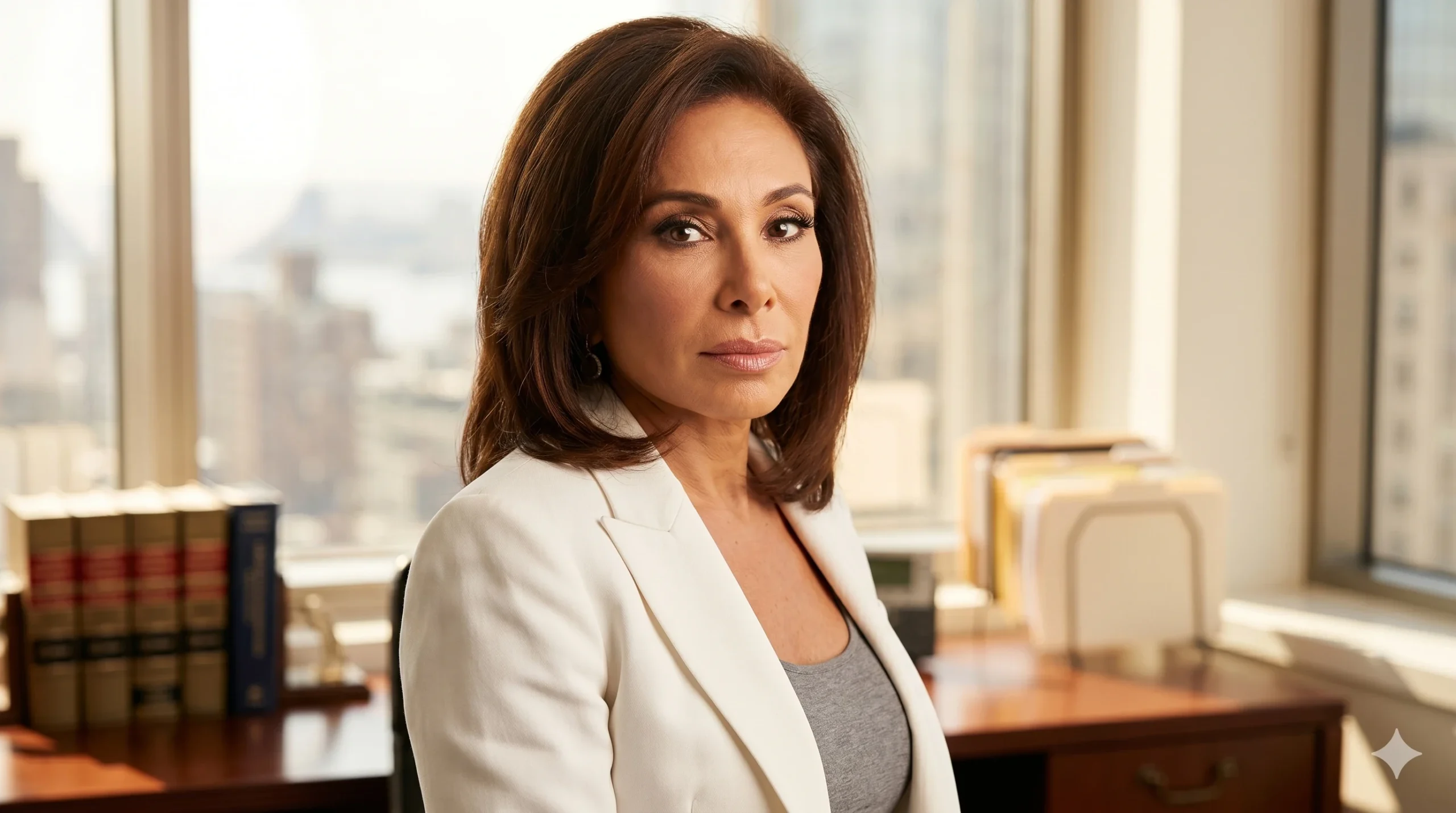
Jeanine Pirro has spent most of her adult life in rooms where people watch closely: courtrooms, campaign halls, television studios, and now a federal prosecutor’s office in Washington. That level of visibility turns even small details into search terms, which is why “judge jeanine left eye” has become a shorthand for viewer curiosity about her appearance. The plain truth is that no verified public medical explanation has been given for Pirro’s left eye, and the more meaningful story is the one behind the face people think they know.
Pirro’s public life has been unusually long and unusually exposed. She has been a prosecutor, judge, district attorney, political candidate, Fox News host, author, Trump ally, and, since 2025, the United States Attorney for the District of Columbia. Her biography is not a straight climb or a simple reinvention story. It is a career built on ambition, courtroom fluency, media instinct, controversy, and a stubborn ability to remain visible after setbacks that would have ended many public careers.
The Real Answer About Judge Jeanine’s Left Eye
The search interest around Judge Jeanine’s left eye appears to come from viewers who have noticed that one eye sometimes looks different in photographs, television clips, or public appearances. Some online posts have speculated about ptosis, aging, injury, cosmetic surgery, or a neurological condition. None of those explanations has been confirmed by Pirro, her office, her doctors, or a reliable source with direct knowledge.
That distinction matters because appearance-based speculation can harden into rumor very quickly. A still frame can catch a person mid-blink, mid-sentence, or under harsh studio lighting, and television makeup can change how eyelids and shadows appear. It is fair to say viewers have asked about her left eye. It is not fair to diagnose her from a screen.
Medical sources describe ptosis as a drooping upper eyelid, and the condition can be linked to aging, trauma, surgery, nerve issues, or muscle problems. But general medical facts do not prove anything about Pirro personally. In her case, the responsible answer is simple: the public record does not confirm a cause.
Early Life in Elmira
Jeanine Ferris Pirro was born on June 2, 1951, in Elmira, New York, a working-class city near the Pennsylvania border. She was raised in a Lebanese American family, the daughter of Nasser Ferris and Esther Ferris. Public biographies have described her father as a mobile-home salesman and her mother as a department-store model who had spent part of her childhood in Beirut.
Pirro’s childhood has often been framed through an early certainty about the law. She has said she wanted to become a lawyer from a young age, and that self-image became part of her public identity later in life. Long before she became “Judge Jeanine” on television, she built the persona of a prosecutor who knew what she wanted and spoke as if doubt were a luxury.
She attended Notre Dame High School in Elmira and graduated early. During high school, she interned in the Chemung County District Attorney’s Office, a small but telling preview of the career she would build. That early exposure gave her a practical look at criminal law before she entered college.
Education and First Ambitions
Pirro earned her bachelor’s degree from the University at Buffalo, then went on to Albany Law School. She received her law degree in 1975 and was an editor of the law review, a credential that signaled both discipline and legal promise. That same year, she began working in the Westchester County District Attorney’s Office.
Her timing was significant. The 1970s were a period when women were still fighting for space in courtrooms, prosecutor’s offices, and judicial politics. Pirro entered law at a moment when gender barriers were not abstract; they shaped hiring, assignments, expectations, and the tone women had to take to be heard.
She did not present herself as tentative. From the beginning, Pirro leaned into a tough-on-crime identity, especially around cases involving domestic violence and child abuse. That focus would become one of the clearest through-lines of her legal career.
Building a Career in Westchester
In 1975, Westchester County District Attorney Carl Vergari hired Pirro as an assistant district attorney. She started with appeals and lower-level cases, but she soon pushed for more attention to domestic violence prosecutions. In 1978, she became the first chief of the office’s Domestic Violence and Child Abuse Bureau.
That bureau became central to her public image. Pirro argued that domestic violence should be treated as a serious criminal matter, not a private family dispute. She developed a reputation for aggressive prosecution and for resisting the idea that cases should automatically be dropped when victims became unwilling or fearful.
This part of her career is often overlooked by people who know her mainly from television. Before the Fox News monologues and political combat, Pirro’s strongest claim to professional standing came from local prosecution. Her courtroom identity was formed in cases involving abuse, family conflict, and the limits of a justice system that had often failed victims.
First Woman Judge in Westchester County Court
Pirro’s rise in Westchester brought her into elected office. In 1990, she became the first woman elected as a judge of the Westchester County Court. The position gave her a title that would follow her for decades, even after she left the bench and became a television figure.
Her time as a judge was relatively brief, but it gave her political and professional authority. She was no longer only a prosecutor pressing cases; she was a public official whose name could carry electoral weight. That combination of legal credentials and camera-ready confidence would later make her a natural fit for cable news.
The title “Judge Jeanine” became more than a résumé line. It turned into a brand, one that suggested firmness, order, and certainty. Whether admired or criticized, Pirro understood the power of that title and used it for the rest of her public life.
Westchester District Attorney
In 1993, Pirro was elected Westchester County District Attorney, becoming the first woman to hold that job. She served from 1994 through 2005, a long tenure that made her one of the most recognizable Republican officials in the New York suburbs. Her office handled local prosecutions in a county known for wealth, political attention, and proximity to New York City media.
As district attorney, Pirro kept domestic violence and crimes against women high in her public messaging. She also became associated with a hard-edged style that mixed legal seriousness with political performance. Reporters found her quotable, television bookers found her comfortable on camera, and political strategists saw a Republican woman who could speak forcefully about crime.
The role also exposed her to scrutiny. A district attorney has to balance public confidence, prosecutorial discretion, and ambition, and Pirro was never a low-profile officeholder. By the early 2000s, she was clearly looking beyond Westchester.
Marriage, Children, and Public Strain
Jeanine Pirro married Albert Pirro in 1975, the same year she received her law degree. The couple had two children, Christi and Alexander, and for years their family life was part of her public profile in Westchester. Albert Pirro was a politically connected lawyer and businessman, and the couple moved in the same legal and political circles that shaped her career.
Their marriage also became a source of public difficulty. Albert Pirro was convicted in 2000 on federal tax conspiracy and tax evasion charges, a case that brought unwanted attention to the family while Jeanine Pirro was still a prominent prosecutor. President Donald Trump later pardoned Albert Pirro near the end of his first term, a fact that became part of the public context around Jeanine Pirro’s later federal appointment.
Jeanine and Albert Pirro eventually divorced in 2013. She has generally kept her children out of the harshest glare of her media and political life. That privacy is one reason responsible profiles should avoid overreaching into family details not placed clearly in the public record.
Political Ambition and Setbacks
Pirro’s ambitions reached statewide politics in the mid-2000s. In 2005, she launched a campaign for the U.S. Senate seat held by Hillary Clinton. The campaign faltered early, including a widely covered announcement in which Pirro lost a page of her speech and paused awkwardly before reporters.
She later left the Senate race and ran for New York attorney general in 2006. That campaign also ended in defeat, with Democrat Andrew Cuomo winning the office. The losses marked a turning point: Pirro’s path to greater power in New York electoral politics narrowed.
But here’s the thing. Pirro did not disappear after those defeats. Instead, she moved more fully toward television, where her legal background, prosecutorial cadence, and taste for confrontation became assets rather than liabilities.
From Courtroom Figure to Television Personality
Pirro’s television career began before she became a Fox News staple. She appeared as a legal analyst and hosted the syndicated courtroom program “Judge Jeanine Pirro,” which won a Daytime Emmy in 2011. That show helped move her from regional legal celebrity to national television personality.
Fox News gave her the larger platform. “Justice with Judge Jeanine” premiered in 2011 and ran for more than a decade. The show mixed legal commentary, crime stories, politics, and sharply delivered opening statements that were often aimed at Democrats, the media, or critics of Donald Trump.
Pirro’s television style was unmistakable. She spoke in declarative sentences, favored moral clarity over hesitation, and built segments around conflict. Viewers who loved her saw strength and plain speech; critics saw exaggeration, partisanship, and a prosecutor’s certainty applied too freely to politics.
Books, Branding, and Public Persona
Pirro also built a publishing career around crime, politics, and her own legal history. Her books include “To Punish and Protect,” “He Killed Them All,” “Liars, Leakers, and Liberals,” “Radicals, Resistance, and Revenge,” “Don’t Lie to Me,” and “Crimes Against America.” She also wrote fiction, including the Dani Fox novels “Sly Fox” and “Clever Fox.”
The books show how Pirro’s brand shifted over time. Early work leaned more directly on her prosecutor identity, while later political books were aimed at conservative readers in the Trump era. Her titles became sharper, more partisan, and more aligned with Fox News audience expectations.
That shift helped her commercially and politically. It also deepened criticism from those who believed she had moved from legal commentator into political advocate. By the late 2010s, Pirro was less a former district attorney who happened to be on television than a central voice in conservative media.
Donald Trump and the Fox Years
Pirro’s relationship with Donald Trump became one of the defining features of her later public life. She was a consistent supporter during his presidency and after the 2020 election. Her Fox platform made her part of a media world that both covered Trump and reinforced his standing with loyal viewers.
That closeness brought influence, but it also brought legal and reputational risk. Pirro was among Fox figures whose statements after the 2020 election drew scrutiny in defamation litigation involving voting-technology companies. Fox News settled Dominion Voting Systems’ defamation case in 2023 for $787.5 million, while Smartmatic’s separate lawsuit has continued through the courts.
Pirro’s defenders point to her legal experience and long prosecutorial record. Her critics point to her media role, her loyalty to Trump, and her participation in a broader conservative message machine. Both parts are necessary to understand her current public standing.
Becoming U.S. Attorney for the District of Columbia
In May 2025, President Trump named Pirro interim U.S. Attorney for the District of Columbia after withdrawing Ed Martin’s nomination. The appointment placed her in one of the most sensitive federal prosecutor roles in the country. The D.C. office handles federal crimes and many local prosecutions in the nation’s capital.
The Senate confirmed Pirro in August 2025 by a 50-45 vote, according to Associated Press reporting. The Justice Department’s official biography now identifies her as the United States Attorney for the District of Columbia and notes her Senate confirmation after serving as interim U.S. Attorney. It also emphasizes her more than three decades in law enforcement.
Her confirmation drew sharply split reactions. Supporters stressed that she had been a prosecutor, judge, and district attorney, unlike some political appointees with thinner courtroom records. Critics focused on her Fox News tenure, her pro-Trump advocacy, and questions about political independence.
Money, Assets, and Net Worth
Pirro’s finances became clearer during her confirmation process. Business Insider reported in 2025 that Pirro disclosed a net worth of $11.6 million in a financial report submitted to the Senate Judiciary Committee. The report said her assets included a Westchester County home valued at about $3.5 million, cash holdings, and brokerage and retirement accounts.
The same reporting said she earned $2.9 million from Fox News between January 2024 and May 2025, along with income from WABC Radio, speeches, and consulting. Those figures are more reliable than many celebrity net worth estimates because they were tied to a disclosure process. Still, any net worth figure should be read as a snapshot rather than a permanent measure of wealth.
Pirro’s income sources reflect the unusual shape of her career. Public service built her authority, television built her fortune, and politics returned her to government. Few figures have moved between those worlds as visibly as she has.
Public Image and Criticism
Pirro’s public image has always depended on certainty. She built a career speaking as someone who knew who was guilty, who was lying, and who deserved punishment. That tone served her well in prosecution and cable news, but it also made her a magnet for backlash.
One major controversy came in 2019 after comments about Representative Ilhan Omar’s hijab drew condemnation and a temporary Fox News absence. Pirro returned to the network, but the episode reinforced criticism that her commentary could veer into inflammatory territory. Her supporters saw the criticism as political policing; her detractors saw a pattern.
There is also a cultural layer to her fame. “Saturday Night Live” parodied her through Cecily Strong’s exaggerated version of Judge Jeanine, turning Pirro into a recognizable character even for viewers who did not watch Fox News. That kind of parody can flatten a person, but it also signals cultural reach.
The Left Eye Rumor in Context
The left-eye search sits at the edge of Pirro’s biography, not at the center of it. It reflects the way modern fame works: public figures are watched so constantly that their faces become open to amateur analysis. A person can spend decades in law and politics and still become a search trend because viewers notice an eyelid.
There is no confirmed evidence that Pirro’s left eye reflects illness, injury, or surgery. Aging, lighting, makeup, facial expression, camera angles, and freeze-frames can all affect how someone appears on screen. A medical explanation is possible in the abstract, but possibility is not proof.
The more respectful approach is to answer the question without feeding the rumor. Readers deserve to know that the claim is unverified. Pirro, like any public figure, deserves not to have a diagnosis assigned to her by strangers online.
Where Judge Jeanine Pirro Is Now
As of April 2026, Pirro serves as the United States Attorney for the District of Columbia. That job places her inside the Justice Department after years of criticizing and defending legal institutions from the outside. It is a striking final act, or perhaps just another turn, in a career built on reinvention.
Her office’s official biography presents her as an experienced law-enforcement figure with roots in prosecution, the judiciary, and victim advocacy. Political coverage presents a more contested picture, emphasizing her relationship with Trump and the partisan fight around her confirmation. Both frames are real, and neither fully cancels the other.
Pirro remains a rare kind of public figure: someone whose earliest credentials were local and legal, whose fame became national and ideological, and whose latest role has returned her to prosecutorial power. Her life is a reminder that American public careers do not always move in clean lines. Sometimes they loop back, carrying all the old applause and all the old controversy with them.
Frequently Asked Questions
What happened to Judge Jeanine’s left eye?
There is no confirmed public explanation for Jeanine Pirro’s left-eye appearance. Viewers have speculated about medical and non-medical causes, but no reliable source has verified an injury, diagnosis, or surgery. The safest answer is that the cause is not publicly known.
Does Judge Jeanine Pirro have ptosis?
Pirro has not publicly confirmed that she has ptosis. Ptosis is a real medical condition involving a drooping upper eyelid, and it can have many causes. Applying that label to Pirro without an examination or confirmed statement would be speculation.
How old is Jeanine Pirro?
Jeanine Pirro was born on June 2, 1951, in Elmira, New York. She turned 74 in June 2025 and will turn 75 in June 2026. Her long public career has covered local prosecution, elected office, national television, publishing, and federal service.
Is Judge Jeanine still on Fox News?
Pirro left her regular Fox News role when she entered federal service in 2025. Before that, she hosted “Justice with Judge Jeanine” and later became a co-host of “The Five.” Her current official role is U.S. Attorney for the District of Columbia.
Was Jeanine Pirro really a judge?
Yes. Pirro was elected to the Westchester County Court in 1990, becoming the first woman elected to that court. She later became Westchester County District Attorney, another first for a woman in that office. The “Judge Jeanine” title comes from her real judicial service, though her time as a judge was only one phase of her career.
What is Jeanine Pirro’s net worth?
A 2025 financial disclosure reported by Business Insider put Pirro’s net worth at about $11.6 million. That figure included real estate, cash, brokerage accounts, and retirement accounts. It should be treated as a reported disclosure-based estimate, not a live measure of her current finances.
Does Jeanine Pirro have children?
Jeanine Pirro has two children with her former husband, Albert Pirro. Their names are Christi and Alexander. She has generally kept her children less visible than her own public life, so responsible coverage should avoid claims about them that are not clearly public.
Read also: June Baranco Biography: Life, Marriage, and Facts
Conclusion
Jeanine Pirro’s left eye may be what brings some readers to the search bar, but it is not the fact that explains her. The verified story is larger and more consequential: a Lebanese American girl from Elmira became a prosecutor, a judge, a district attorney, a television star, a political combatant, and finally a Senate-confirmed U.S. Attorney in Washington.
Her career contains real achievement and real controversy. She broke barriers in Westchester, helped put domestic violence prosecution at the center of her legal identity, and later became one of conservative media’s most recognizable voices. She also tied her public standing closely to Trump-era politics, a choice that brought power, loyalty, criticism, and legal scrutiny.
The truth is, Pirro’s staying power comes from the same qualities that divide audiences: confidence, combativeness, discipline, and a talent for performance. She has never been a background figure. Whether standing in court, speaking into a Fox News camera, or leading a major prosecutor’s office, she has made herself impossible to ignore.
The most honest way to cover her is to keep both things in view. The left-eye speculation remains unverified and should be treated with restraint. The life behind the search, though, is fully public, deeply documented, and still unfolding.